
Kite Surfing in the Algarve
Already a kiter, or thinking about picking it up? The Algarve has flat-water lagoons, a reliable thermal wind, and twenty years of kite instruction in Lagos. Here’s everything worth knowing.
All kite activities in Lagos
A full week’s camp, day lessons, wing foil, or rental — there’s a format for every trip and every level.

Kite Camp
A full week, all-in: accommodation, meals, daily kite instruction, VDWS licence, wake park day, and equipment. Five days of Nortada — nothing left to sort.
From €1,200 / week

Kite Lessons
Group, semi-private, and private lessons by the day at Ria de Alvor lagoon. Max 4 per group. IKO + VDWS certified instructors. All equipment included.
From €125 / day

Wing Foiling
The fastest-growing wind sport in the Algarve. Group wing control sessions on Meia Praia or the lagoon — no prior kite or foil experience required.
From €90 / day

Kite Rental
Instructor-approved rental after completing lessons with AWS. Full equipment at the lagoon. Prior AWS lesson required — a proper introduction to the spot is mandatory before solo riding.
From €80 / day
Why the Algarve works for kitesurfing
The Algarve’s wind comes from the north. The Nortada is a thermal wind driven by the temperature difference between the hot Alentejo plains inland and the cooler Atlantic coast. On a classic summer day, the morning starts calm or with a light southerly. Around 1:00–2:00 PM there is a clear switch: the north wind fills in and ramps up to 15–25 knots within the hour. Once it starts, it is consistent through the afternoon. You know the pattern. You plan your morning. You kite from afternoon until sunset.
The wind is also channelled by the landscape. Between Lagos and the Serra de Monchique — the mountain range to the north — the terrain funnels and accelerates the Nortada. The teaching lagoon at Ria de Alvor typically sees averages of 18–22 knots during peak season, even on days when the coast further south barely has a breeze.
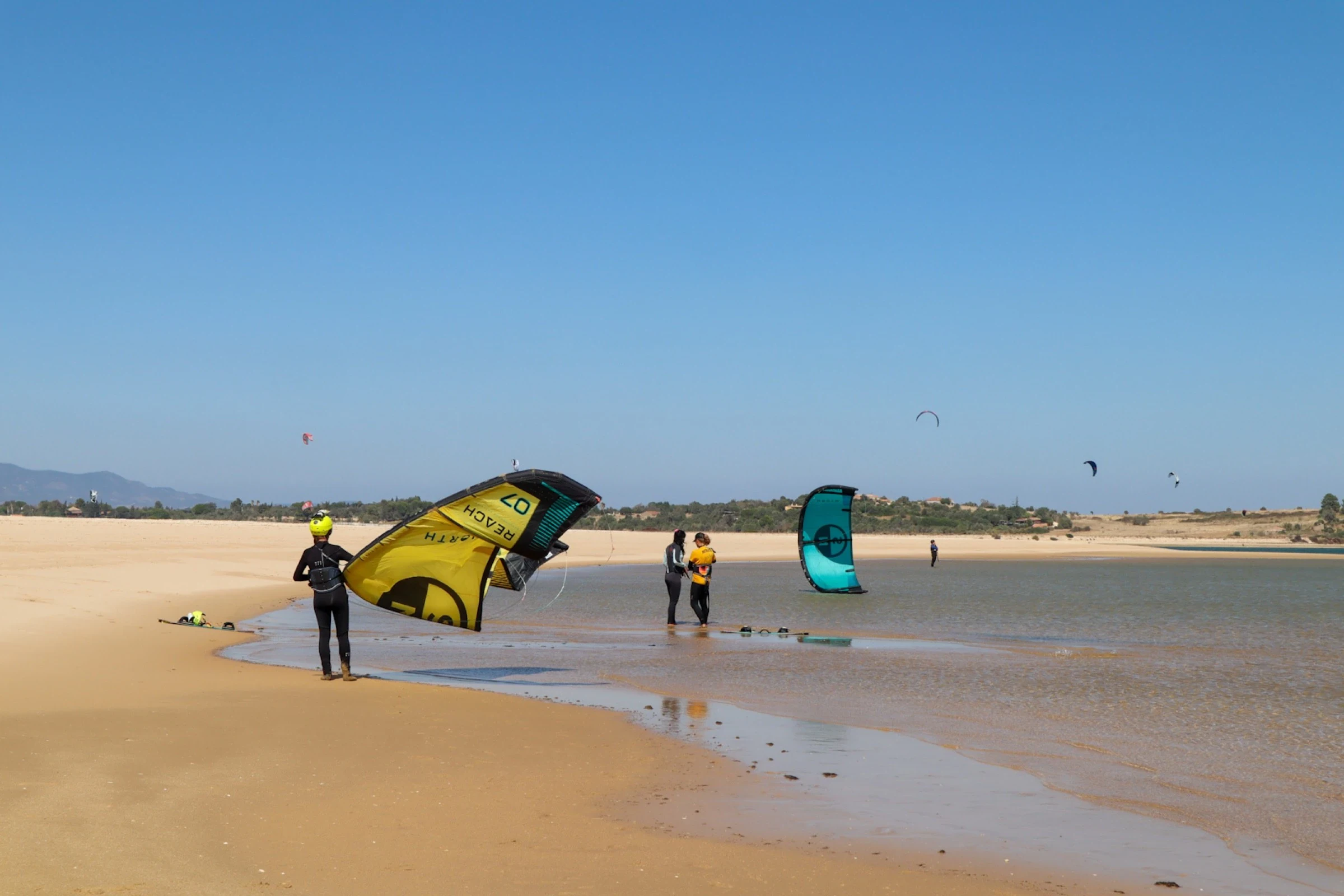
The teaching location itself is a tidal lagoon between Lagos and Alvor. Flat water. Sandy floor. Shallow enough to stand through most sessions. The sand banks spread across the lagoon keep the water knee- to waist-high across the main teaching area, which makes it genuinely easy for beginners to recover and reset. When the Nortada fills in, it becomes one of the cleanest learning environments in southern Europe.
Wind doesn’t blow every day — especially in April, September, and October. AWS runs six water sports from one location: kitesurfing, surfing, wing foiling, windsurfing, wakeboarding, and SUP. If there’s no wind, you surf or wakeboard. Credit stays valid. No week is a write-off.
Kite camp includes a day at the cable wake park. The water start on a cable wake is almost identical to a kite water start — you learn board feel without the added complexity of controlling a kite. When you come back to kite and board on Day 3–4, the board part already feels familiar. It speeds up the learning curve noticeably.
The Kite House
The base for kite weeks is the Kite House — a dedicated watersports camp above Meia Praia beach, five minutes on foot from the centre of Lagos. Accommodation ranges from dorms and twin rooms to private bungalows depending on preference and season. There is a pool, an outdoor bar (the Baraka-Bar), and a kitchen producing three meals a day for camp guests. Breakfast before the morning is yours. Lunch after the lagoon. Dinner when the energy has come back.
In the evening the vibe shifts from the water to the poolside. You share food and a lot of retelling of the day’s sessions with other kiters, surfers, and wing foilers from across Europe — German, Polish, and Dutch guests make up a big share of the summer kite crowd, with most sessions at the lagoon mixing four or five nationalities on the water. By day three or four, the group has usually found its rhythm: inside jokes have started, the impromptu coaching on the beach has become constant, and someone has already decided to extend their stay.
It is one of the things that separates a week here from day lessons at a kite school that sends you home after the session. The water time is the same. The rest of it is not.
Kite spots near Lagos
Two very different environments — one for learning, one for those who can already ride.
Ria de Alvor Lagoon
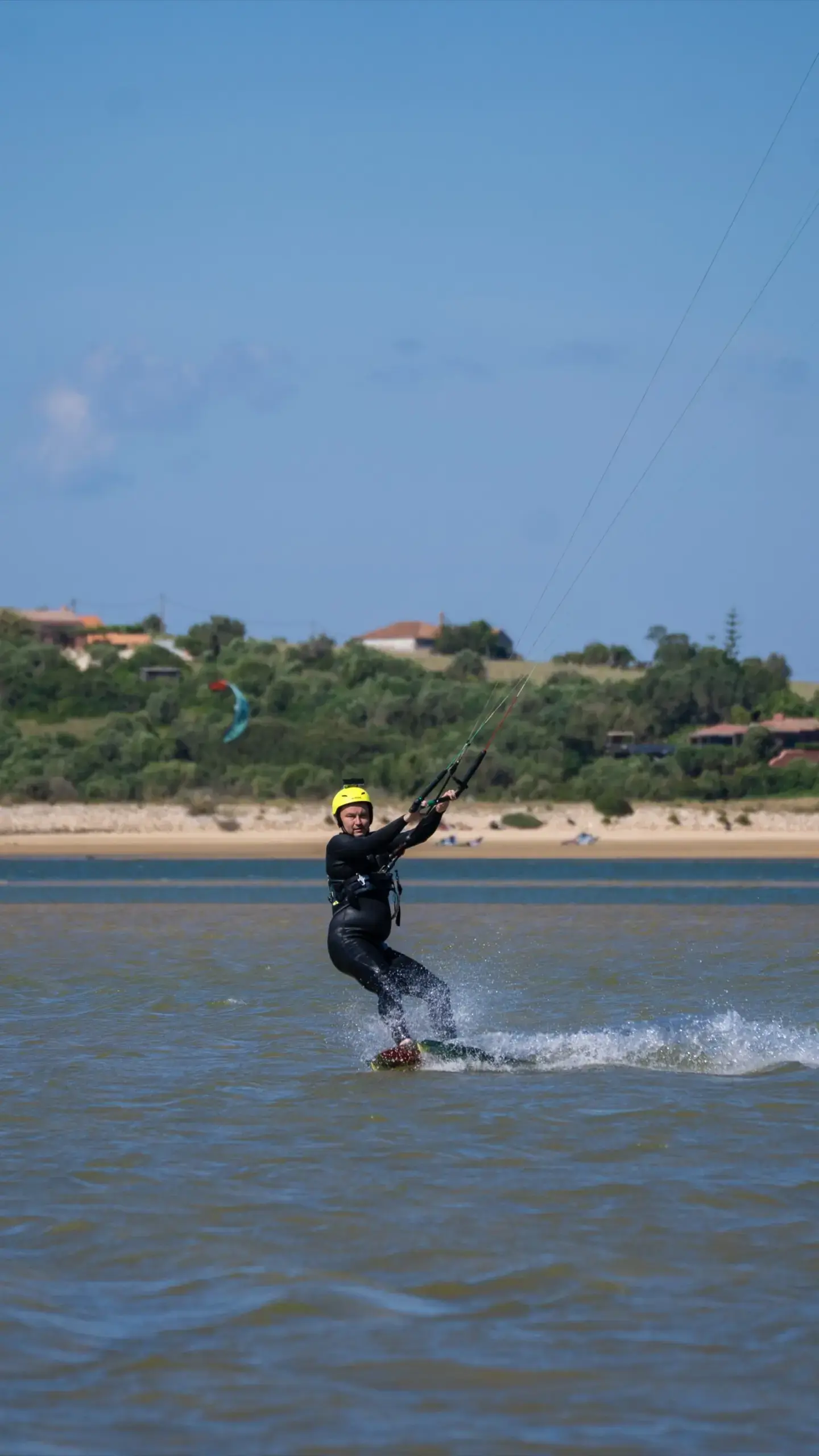
A sheltered tidal inlet between Lagos and Alvor. The wind funnels in from the north, channelled by the Serra de Monchique mountain range to the north, and arrives at the lagoon with a clean, consistent angle. Average wind during a proper Nortada afternoon: 18–22 knots.
Sand banks across the teaching area keep the water knee- to waist-high. Sandy floor. Shallow enough to stand throughout the lesson. Beginners spend their first sessions on kite control and body drag in the shallows — once you start boarding, the whole lagoon opens up. Tide-dependent: lessons are planned around the tidal window the day before, based on the forecast. When conditions align, this is one of the best kite learning spots on the Portuguese coast.

Meia Praia Beach
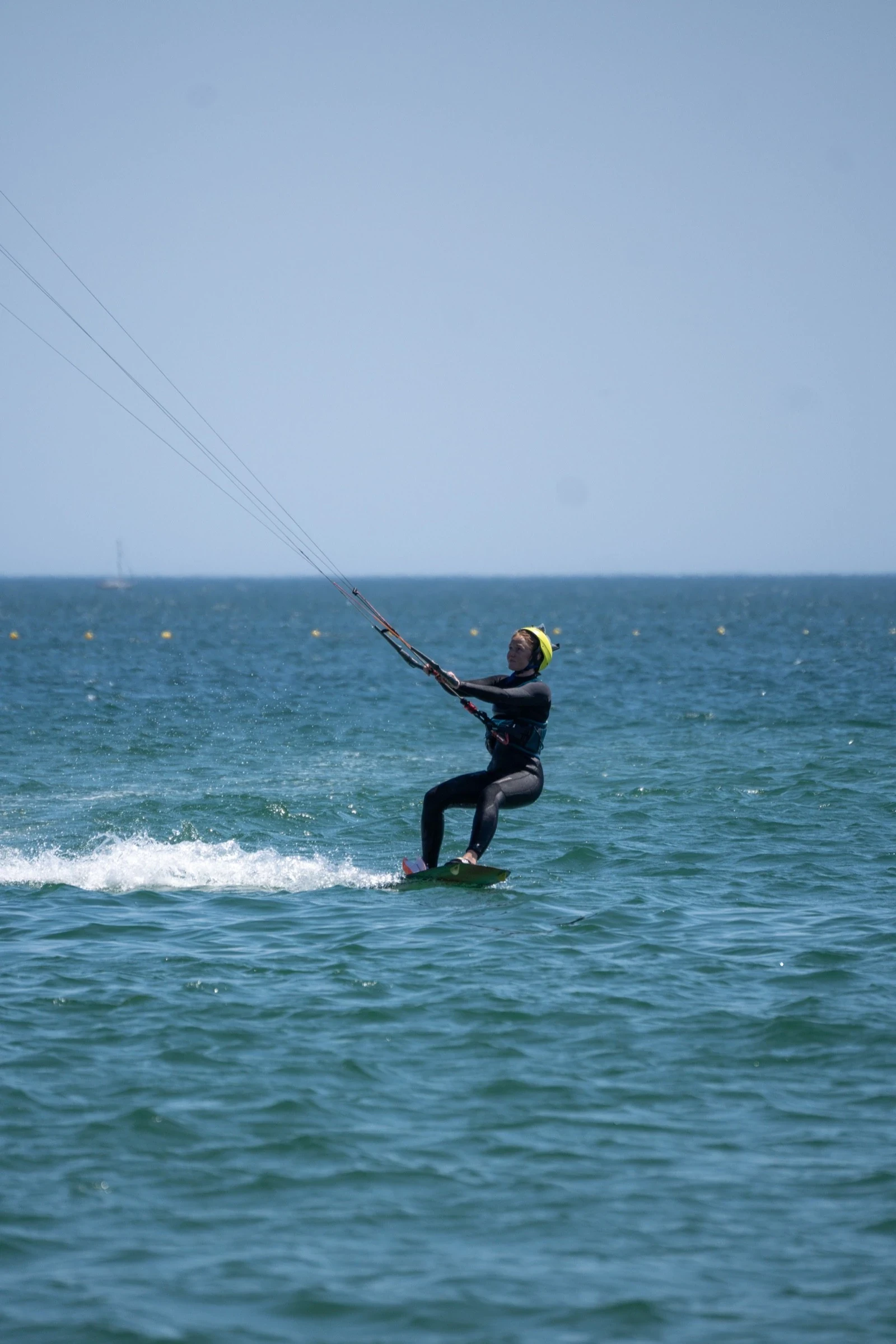
When the tide doesn’t suit the lagoon, lessons move to Meia Praia — Lagos’s long Atlantic beach. Deep water sessions with radio communication between instructor and student, and a safety boat available for pick-up. More space than the lagoon, which suits riders who are already riding and want to work on upwind, distance, or speed.
The wind at Meia Praia is offshore and slightly more variable than the lagoon. It rewards riders who already have basic board control and kite awareness. Beginners can session here too — the approach and safety protocols are different but the learning environment is safe. Plan for the day is always communicated the evening before.
Find your level
Kitesurfing has a real progression system — your level determines which lesson format is right for you.
Never touched a kite — or just started
You start with kite theory, wind dynamics, and kite setup. Day 1 is all control — making sure the kite obeys you, not the other way around. Group lessons (max 4 students, 3 hours) are the right format for L0–2. You share a kite with one other student so you get focused coaching time.
- Group lessons available — max 4 students, 2 kites
- Day 1: safety, wind theory, kite control on land
- Day 2: body dragging — kite pulls you through the water
- Day 3: board introduction, first water start attempts
- Wake park day builds board feel without kite complexity
- VDWS licence included with kite camp packages
Read the beginner’s guide to kitesurfing lessons in Lagos — covers what to expect day by day, how the lagoon works, and which lesson format suits you.
You can water start — now ride upwind
You have kite control and your first water starts — but riding upwind isn’t happening yet, or it’s inconsistent. This is the most common level for returning kite students. At L3+ you must do semi-private or private only — no group lessons. You have your own kite and the full session is focused on your progression.
- Semi-private only — your own kite, 2.5 hours
- Focus: upwind technique, board control, riding distance
- Instructor feedback in real time via radio or water
- Intermediate camp package available (5 semi-private + wake)
- Deep water Meia Praia sessions available for more space
You ride comfortably — coaching, rental, or something new
You ride upwind reliably and want focused sessions on specific skills — jumps, transitions, strapless, riding direction switches, or your first foil lesson. Semi-private and private coaching both work. Rental is available after an AWS lesson at the spot — the lagoon has currents and wind gaps that need a local introduction before independent riding.
- Coaching on jumps, transitions, strapless, or foiling
- Semi-private or private — your own kite, full session
- Rental from €80/day — instructor-approved after AWS lesson
- Wing foiling on lighter wind days (10–15 knots) — ask about sessions
- Prior VDWS or IKO licence accepted with spot introduction
Kite conditions by month
The Nortada thermal season runs May through September. Here’s what to expect, month by month.
| Period | Wind Reliability | Wind Speed | Water Temp | Wetsuit | Crowds |
|---|---|---|---|---|---|
| April | Low — unreliable | VariableNortada not established yet | 17–18°C | 4/3mm | Very low |
| May | Building — 2–3 days/week | 10–20ktSeason starting, lighter days | 18–19°C | 4/3mm | Low |
| June ★ | High — 4–5 days/week | 15–25ktFull Nortada, reliable afternoon kick | 19–20°C | 3/2mm | Medium |
| July ★ | Very high — 5–7 days/week | 18–28ktPeak season, sometimes every day | 20–21°C | 3/2mm or none | High |
| August | High — 4–6 days/week | 15–25ktStrong and consistent | 21–22°C | 3/2mm or none | Very high |
| September | Medium — 2–4 days/week | 10–20ktThermal fading, lighter days returning | 20–21°C | 3/2mm | Medium |
| October | Low — unreliable | VariableThermal season closed, occasional fronts | 19–20°C | 4/3mm | Low |
Sweet spot: June and July. June gives you the best combination — reliable Nortada (4–5 days per week), warm water, and beaches that aren’t at August capacity yet. July is the windiest month: five to seven wind days per week, sometimes every single day, with 18–28 knots in the afternoon. For those targeting maximum kite time in a single week, July is the call. April, September, and October are off-season — for those months, book a surf camp and upgrade to kiting when conditions allow.
How the Nortada works
The Nortada is a thermal wind driven by the temperature difference between the hot Alentejo plains inland and the cooler Atlantic. On a classic wind day, the morning starts calm or with a light southerly. Around 1:00–2:00 PM there is a dramatic switch: the north wind fills in and ramps up quickly to full strength. Once it starts, it is consistent — it will not drop until late evening. This predictability is what makes the Algarve so good for kitesurfing. You know the pattern. You plan your morning. You kite in the afternoon.
The wind is technically offshore at the lagoon, which means it blows from the land out to sea. This creates a cleaner, more consistent angle for teaching — but it also means you need a proper introduction to the spot before riding independently. That’s why we require at least one lesson with AWS before rental.
What happens on no-wind days
When the wind doesn’t blow, the plan for the next day is communicated the evening before — you always know what to expect. No-wind days become surf days, wake park days, SUP tours, or free time. Credit from an unused kite lesson goes toward any activity, the shop, the bar, or a future stay. There is no cash refund for wind-cancelled lessons — but no week is ever wasted.
For April, September, and October bookings: we recommend booking a surf camp and treating kite lessons as an upgrade when conditions allow. Wind in those months is possible — just not reliable enough to base a booking on. For guaranteed kite time, book June, July, or August.
Kite guides and articles
Planning your kite trip? These guides answer what we get asked most.
Best spots to kitesurf in Lagos
A local instructor’s breakdown of every kite-accessible spot near Lagos — what makes each one work, the conditions it needs, and which level it suits.
Read the guide →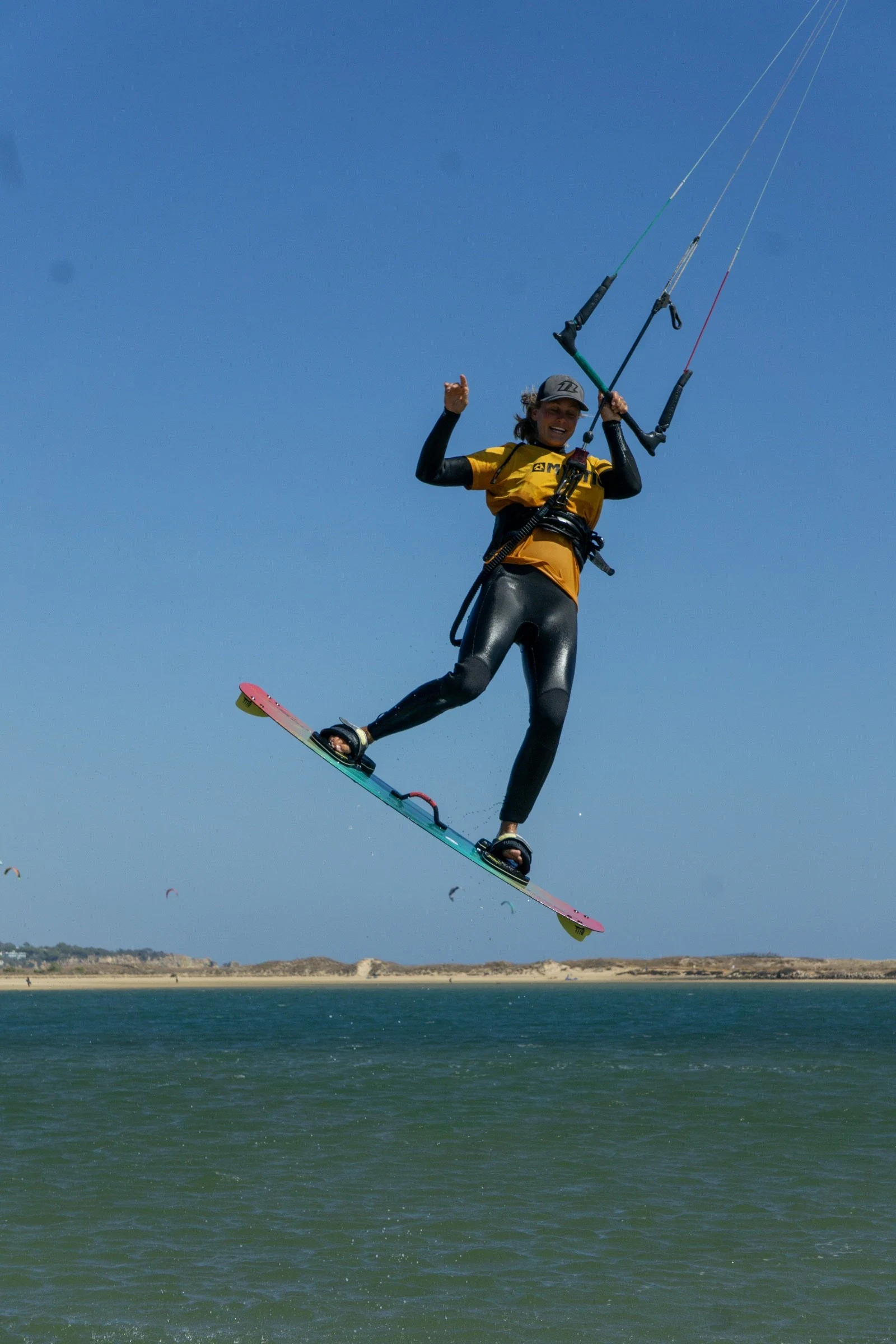

Kite disciplines
Kitesurfing has split into distinct styles over the last decade. Here’s what each one involves and who it is for.
Freeride — boosting on flat water
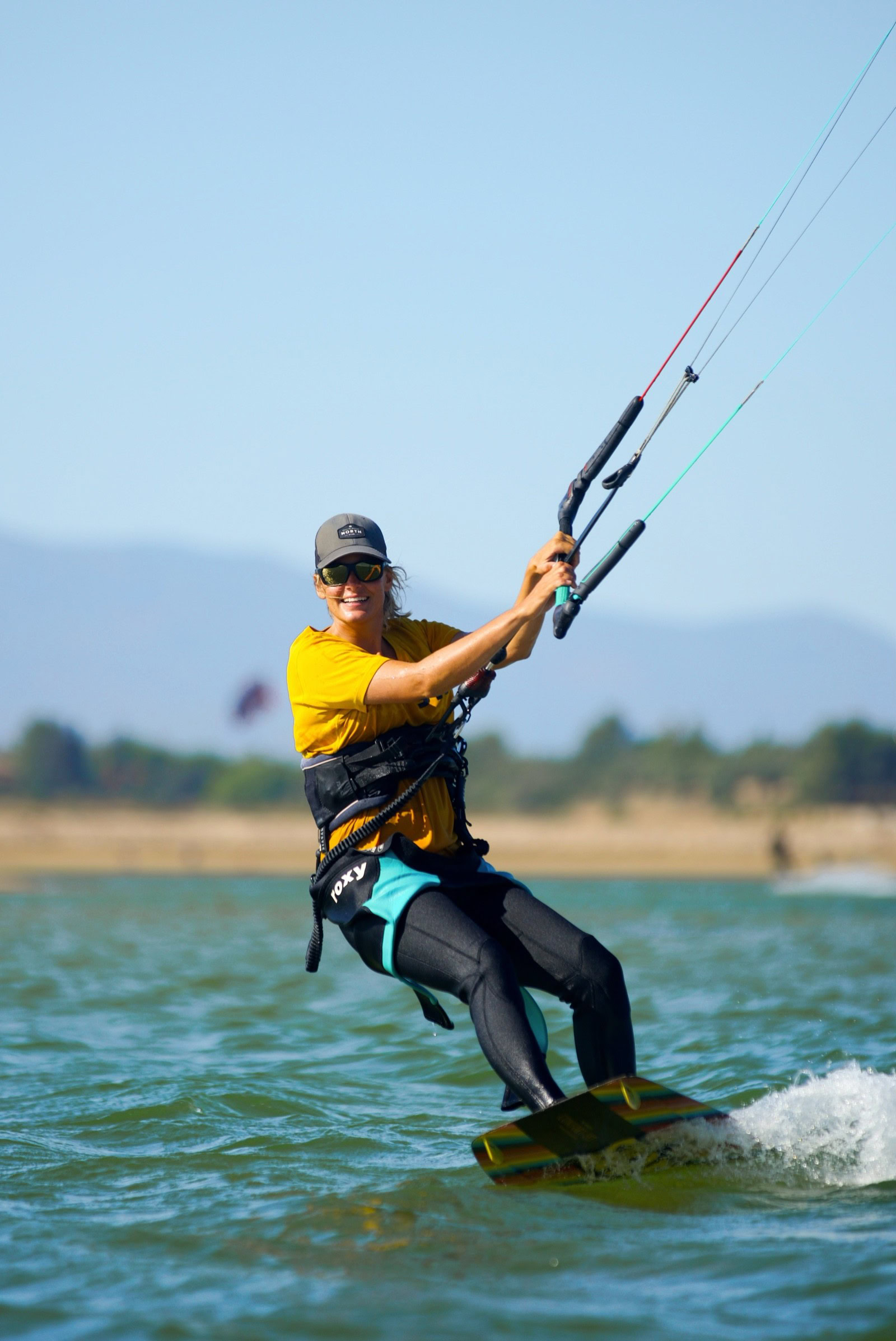
Jumping, riding, having fun — this is what most people come for and what most people keep doing for years. Twin-tip board, riding in both directions, chasing the magic gust. What makes the Ria de Alvor genuinely special for freeride is the combination of flat water and the strong Nortada. When the wind really fills in — high 20s knots — a 9m kite on this lagoon generates serious lift. The highest jump recorded here is 15m+. You are not just riding around; you are flying. On a good July afternoon the lagoon turns into a world-class boosting spot.
Freestyle — unhooked moves, handle passes
You unhook from the kite’s depower system and ride raw — handle passes, S-bends, kite loops, landing blind. Every trick depends on kite position, timing, and committing through the rotation. The Alvor lagoon is actually a good freestyle spot: glassy flat water and room to reset between attempts. The catch is the Nortada. When it really fills in, the wind gets strong and gusty, which makes timing unhooked moves harder. The better call for freestyle is a south-wind day, or the lighter southerly that sometimes comes through around midday when the Nortada hasn’t kicked in yet. Ask your instructor — they’ll know when conditions line up.
Strapless freestyle — rotations, showies, grabs
Kitesurfing with a surfboard and no foot straps — but this is not about wave riding or carving turns. The focus is aerial: rotations, showies, board grabs, handle passes while the board is off your feet. Without bindings, the pop and landing feel completely different. The lagoon is a solid spot for it — flat water means you focus on the trick, not on managing a wave face. Wave strapless does happen at this coast: Meia Praia on a south-wind day occasionally works, and Bordeira further west is a proper wave beach. But in summer, flat-water strapless freestyle at the lagoon is the realistic option.
Foil — lagoon and Meia Praia
The hydrofoil lifts the board above the water entirely. Silent, fast, possible in 10 knots of wind where a twintip would not move. At the lagoon, foiling works well — go at high tide for the most depth and room. Meia Praia is arguably the better foil spot: open space, easy take-offs and landings, and plenty of room to build speed. One advantage of foiling over a twintip is how it handles gusty wind — the foil smooths out the pull variations, so conditions that feel inconsistent on a twintip are often perfectly rideable on a foil. Foil sessions available for riders already comfortable upwind on a twintip — ask your instructor.
You do not need to bring any equipment. Kite, bar and lines, board, harness, helmet, wetsuit, and impact vest are all included with every lesson and camp booking. We fly North and Cabrinha kites, ride Shinn and Cabrinha boards, and use Mystic harnesses. Your instructor selects the right kite size for your weight and the day’s wind. If you have your own gear, bring it — your instructor will check it and advise if needed.
VDWS — the kitesurfing licence
VDWS is the internationally recognised standard for kite instruction. Here’s how the certification system works and what you earn during a kite course.
What is VDWS?
VDWS stands for Verband Deutscher Wassersport Schulen — the German Association of Watersport Schools. Founded in Germany, it has grown into one of the most widely accepted watersport certifications worldwide. Algarve Watersport is a certified VDWS centre, which means our instructors are trained to the VDWS standard and our courses are structured around the official VDWS progression system.
At the end of a qualifying course, you receive a personal VDWS kiteboarding licence card with your name, photo, and licence number. Each level you complete is recorded on the card with a sticker. This licence is recognised at kite rental stations, shops, and schools across Europe and beyond — you can show up at a new spot and immediately demonstrate your level without having to explain it.
The system has seven levels plus a theory level. The basic kite licence requires passing Level 5 and the theory test. Most students completing a five-day kite camp reach Level 5 — some get to Level 6. Level 7 covers tricks and advanced techniques that typically take additional weeks of practice.
How the licence is issued
Your instructor assesses your progress throughout the course. At the end of the last session, you do a short practical check and a written theory test. Both are straightforward for anyone who has completed the course — the theory covers wind safety, right of way rules, spot knowledge, and basic kite physics. Pass both, and the VDWS licence is yours to take home.
The licence is included in all kite camp packages. For day lesson bookings, ask about adding it when you enquire — it is not included by default but can be arranged.
VDWS level system
Seven levels, each with a practical skill requirement. You progress at your own pace — there is no pressure to reach a specific level by a set date.
| Level | What you need to demonstrate |
|---|---|
| 1 | Safety fundamentals, kite setup, flying a trainer kite, bodydrag introduction |
| 2 | Controlled bodydrag, relaunch from the water |
| 3 | Water start, riding downwind at least 50 metres |
| Theory | Written test: wind theory, safety rules, right of way, spot knowledge |
| 4 | Riding downwind, direction changes, basic jibe, holding position in the wind window |
| 5 | Riding upwind — the standard for the basic kite licence. Most camp students reach this in five days. |
| 6 | Basic jumps and carved jibes, or transition jumps |
| 7 | Rotations or kite loops, grabs, one-foot riding, board-off, or railey |
The VDWS licence is also accepted at IKO-certified stations with a spot introduction. If you already hold a VDWS card at Level 5 or above, you do not need to start from scratch — a brief spot briefing at the Alvor lagoon is sufficient before independent rental.
What kite guests say
1,300+ reviews across Google and TripAdvisor. A few that stand out from kite week guests.
“Extremely professional and friendly crew, with many years of kite experience. Good spot for all levels. Fun and laid-back atmosphere.”
“This past week spent at the Kitehouse was by far the best experience of my life. Being surrounded by so many positive and happy people and having so many exciting experiences made me want to stay there forever.”
“Place was clean with awesome food and atmosphere! It was my first time doing kitesurfing camp. The staff is very helpful, the food was amazing.”
Frequently asked questions
Everything we get asked about kitesurfing in Lagos — answered honestly.
June and July are the best months. June gives you 4–5 wind days per week, warm water, and quieter beaches than August. July is the peak — five to seven wind days per week, sometimes every single day, with the Nortada blowing 18–28 knots in the afternoon. August is also excellent but busier. May is building and worth a go, but not reliable enough to plan a kite week around. April, September, and October are off-season — for those months, book a surf camp and upgrade to kiting when conditions allow.
Yes — kite, bar and lines, board, harness, helmet, wetsuit, and impact vest if required are all included with every lesson and camp booking. The only thing we don’t supply is neoprene booties — these break too quickly with shared use. They are available for purchase in our kite shop if you want foot protection at the lagoon. You do not need to bring any equipment.
In June and July the Nortada thermal is highly reliable — 4 to 7 wind days per week, usually kicking in between 1:00 and 2:00 PM and staying strong through the afternoon. August is nearly as consistent. Outside the core thermal season — especially April, September, and October — wind is possible but cannot be guaranteed. When we have wind, the lagoon is one of Portugal’s cleanest teaching environments. On no-wind days, the team communicates plans the evening before so you always know what to expect.
Yes. The Ria de Alvor has a sandy floor, shallow teaching areas where you can stand throughout the lesson, and a consistent wind angle. Your instructor designates the area for each session — you stay in the shallows during kite control and body dragging. There are deeper sections of the lagoon, but beginners stay out of them. The lagoon has some shells on the bottom and occasional rocks — minor shell cuts on soft feet are possible and not unusual in kitesurfing. Neoprene booties help if you want extra protection. Overall, it is one of the safest kite learning spots on the Portuguese coast.
The VDWS (Verband Deutscher Wassersport Schulen) licence is an internationally recognised kite certification. It is included in all kite camp packages. At the end of your camp week, you take a practical and written test and receive a card showing whatever level you have reached. The licence can be used to rent equipment at kite schools and stations worldwide that accept VDWS certification. For day lesson bookings, the licence is not automatically included — ask if you want to add it. You don’t need a licence before arriving — you earn it during the week.
Yes — this is one of the things that makes AWS different. We offer six water sports at one location: kitesurfing, surfing, wing foiling, windsurfing, wakeboarding, and SUP. Camp guests can switch sports any day at no extra cost. The typical kite week mixes kite afternoons with surf or wake mornings. If the wind drops for two or three days, you spend those days surfing, then return to kiting when it returns. No other camp in Lagos makes this easy.
For group lessons: minimum age 16, weight range 50–95kg. For semi-private: minimum age 16, weight range 45–120kg. For private lessons: minimum age 10, weight range 30–120kg. Weight limits exist because kite sizes and safety systems are calibrated around these ranges — outside them, it becomes difficult to set up correctly for you. If you are close to a limit, contact us before booking — we can usually advise on the right format.
Not without at least one AWS lesson first. Even with certification, the Alvor lagoon has currents, wind gaps, and local hazards that are specific to the spot. You need a proper introduction to know where to ride and where not to go before riding independently. Your instructor will quickly check your existing skills — body drag upwind, kite control — and if solid, the introduction lesson can be short. Think of it as a spot briefing, not a re-learning session. After that, rental is available at lesson times and locations only.
Ready to kite in Lagos?
Lessons by the day or a full kite camp week — both at the same lagoon, the same instructors, and the same reliable Nortada. Pick your format.