Surfing Portugal vs Bali and Sri Lanka: An Instructor’s Honest Take
I’ve surfed Bali, Sri Lanka, and coached in Portugal for years. The honest answer is not what most travel blogs say.
Every season I get some version of the same question. Someone has a week free, they want to go surfing, and they’re trying to decide between Portugal and Bali — or maybe Sri Lanka, or the Philippines. They want an honest answer. Usually what they’ve found online is too vague to actually help.
I’ve surfed Bali and Sri Lanka. I teach surf in the Algarve every season. I’ll give you the same answer I give the guests who ask me face to face — no softening, no destination marketing. It really does depend on a few things, but those things are specific enough to be useful.
The travel math nobody mentions
A flight from most of Western Europe to Bali takes 15 to 18 hours with at least one stop. You land exhausted. You need a day to recover before you’re functional in the ocean. Then you do it again on the way home.
On a 7-day trip: 2 days travel out, 1 day recovery, 2 days travel back. That’s 4 days, minimum, that aren’t surfing. You’re left with 3 to 4 actual sessions if everything goes smoothly. People don’t put it in those terms when they’re looking at surf camps online, but that’s the arithmetic.
“A 7-day trip to Bali is really a 4-day trip if you’re honest about the travel and recovery time.”
Angel, Head Surf InstructorPortugal from most European cities is a 2 to 3 hour direct flight. You land mid-afternoon, you’re at the beach the next morning. The week is a full week.
Two weeks in Bali or Sri Lanka changes the calculation. The travel days are a smaller percentage of a 14-day trip, and you land with time to recover properly. Three weeks would be even better — that’s really the trip shape that works for Asia. One week in Bali is a great holiday. It’s just not a great surf week.
For anyone asking about getting to Lagos specifically, the journey from most European capitals is one of the shortest possible for a surf destination with serious waves.
The waves — what the Instagram posts leave out
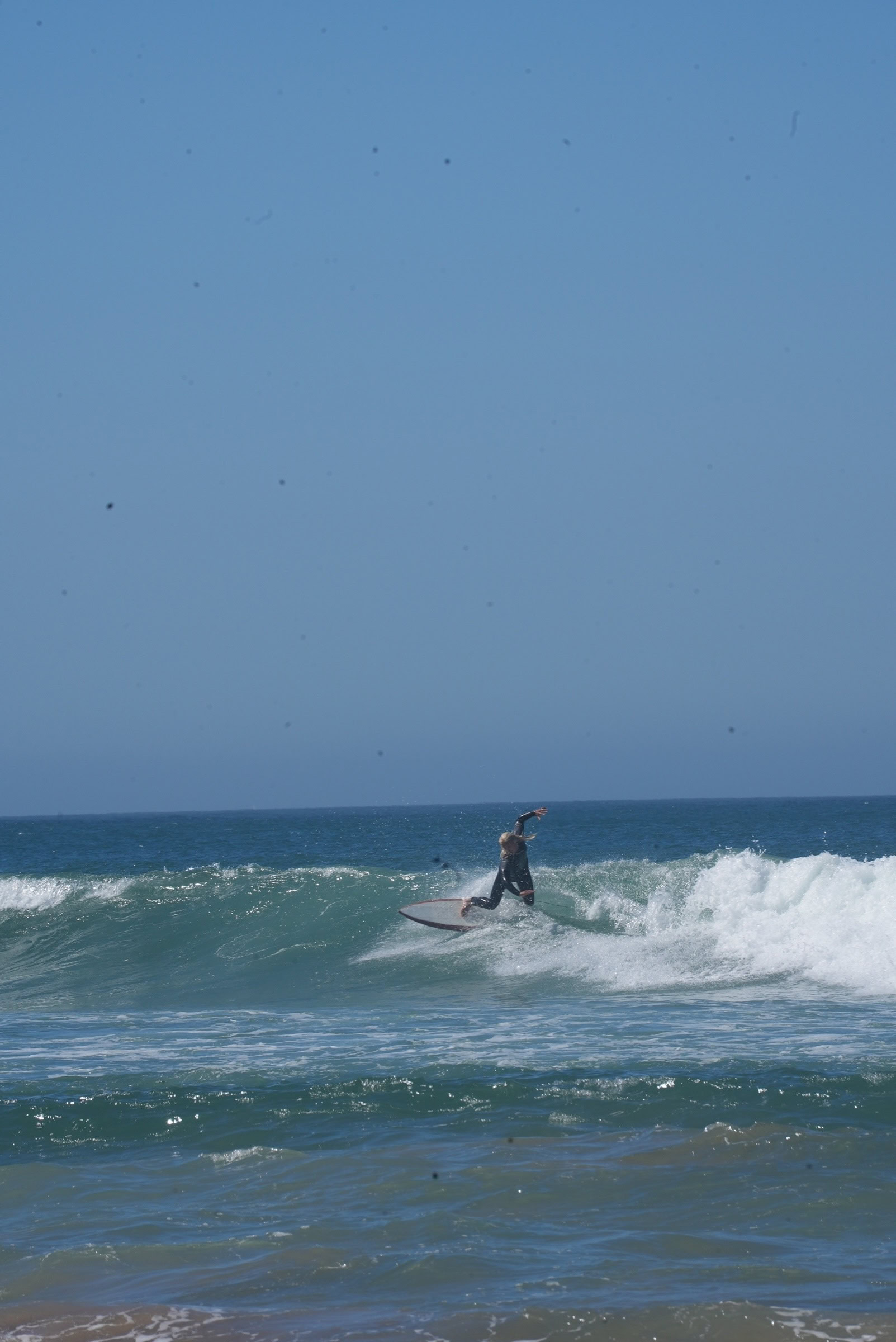
Bali
The waves in Bali are genuinely different from the Atlantic, and for intermediate surfers, they are a privilege. The open faces are longer and softer at takeoff than most European beach breaks. You can comfortably surf one size bigger than you’d manage in Portugal: if you’re riding 1.5 metre waves here, you’ll be comfortable on 2 metres in Bali. The warm water and the softness of the swells give you more time on the face.
This is not a myth or travel marketing. It’s real. An experienced surfer who can read water and handle reef breaks will have an incredible time there. I did.
Sri Lanka
Sri Lanka gets described as a beginner paradise. I’d push back on that. Most of the breaks I surfed there are reef breaks. Beautiful. Genuinely beautiful. But reef is unforgiving, and a wipeout at the wrong angle on shallow coral is a different kind of fall from a sand-bottom beach break in the Algarve. It’s not unsurvivable, but it’s not a beginner learning environment either.
There’s also a tourism pressure issue on the reefs that I’d want any ecologically-minded surfer to be aware of. Mass surf tourism on coral reef ecosystems has caused visible damage at several well-known spots.
Portugal
Atlantic beach breaks. Consistent year-round swell. Technically demanding compared to Bali, which is part of the point for anyone trying to build real surfing fundamentals. The Algarve coast gives us several beach options depending on conditions: different breaks, different swell directions, and we choose the night before based on the forecast.
Beach breaks teach you to read waves. That skill transfers to every other surf destination you’ll ever visit. Learning on a soft, gentle Bali face is enjoyable, but it doesn’t always build the same foundation.
The crowd problem
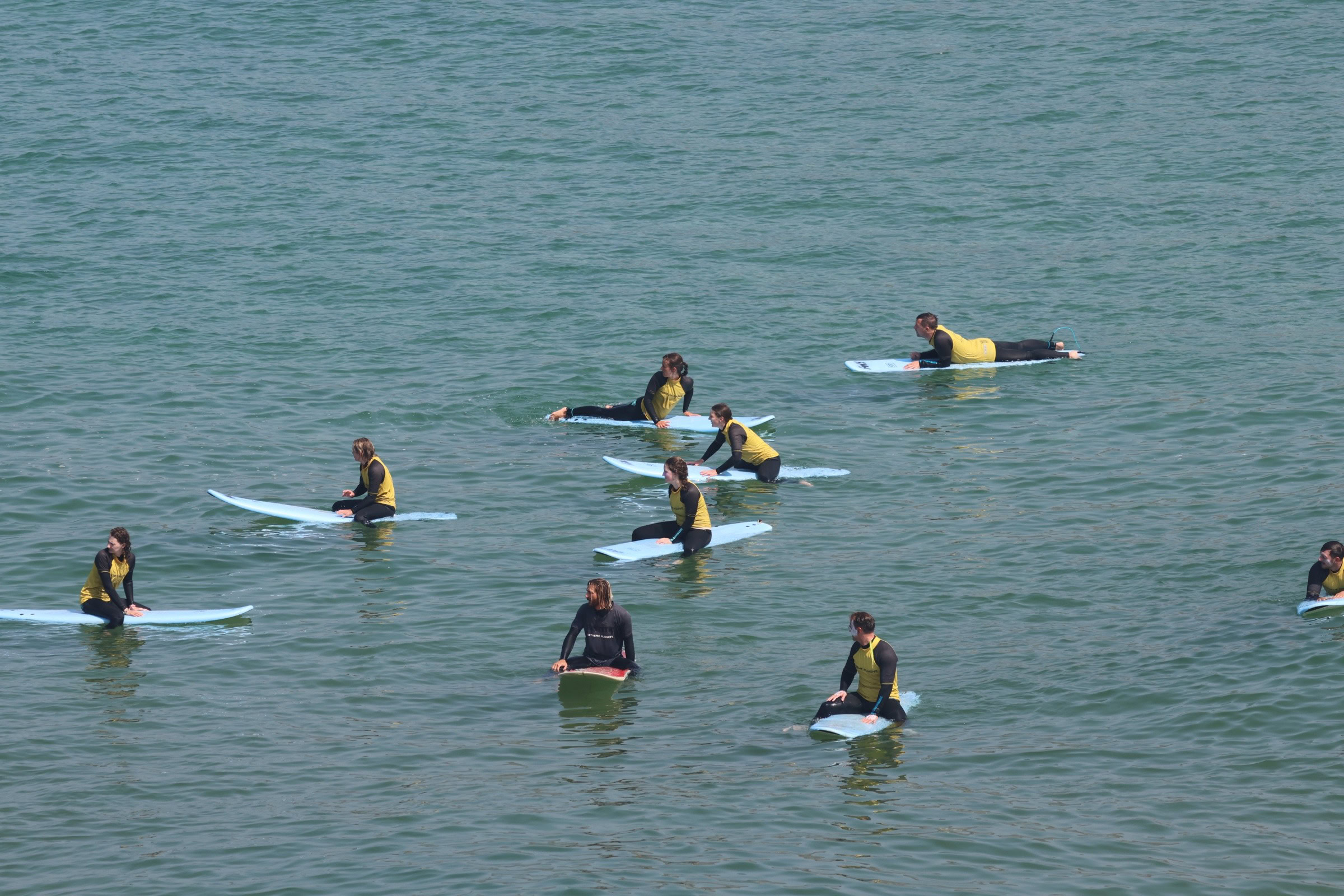
Bali’s surf spots have a crowd problem that goes beyond the usual “it’s busy in peak season” kind of busy. On the popular reef breaks, you’ll find people with no idea where to sit in a lineup, no awareness of right of way, and no real ability to control their boards. On a beach break that’s annoying. On a reef break it’s a different thing — for them and for everyone around them.
The summer months (July and August) make this worse for a specific reason: Bali is a short flight from Australia. When Australians take their winter holiday, Bali fills up fast. I’ve been there and it’s real — at the busy spots you’re sharing a wave with ten other people, and several of them are experienced Australian surfers who’ve been surfing that break for years. You’re not going to out-position them. If you’re a beginner or lower intermediate, you’re basically watching from the shoulder.
Portugal has its own crowds in summer, especially at well-known spots. But the density is different, and our lessons are run at breaks and at times chosen specifically to give beginners room — not pushed into a full lineup.
For context on the best beaches we use for beginners, the beginner surf guide covers the conditions and what to expect from the first session.
Who’s teaching you
This is the section I want to be direct about, because it gets glossed over in destination comparisons.
In Bali and Sri Lanka, the surf instructor industry is large, loosely regulated, and in some places Instagram-optimised rather than teaching-optimised. You’ll find excellent instructors there. You’ll also find people whose main credential is a good tan and a large following. Telling the difference from a booking page is genuinely hard.
In Portugal, the teaching standard is set by the IPDJ — Instituto Português do Desporto e Juventude. The qualification is called the TPTD (Título Profissional de Treinador de Desporto), and it’s the legal national licence required to teach surf professionally here. It exists independently of international surf associations. It’s a real professional qualification, not a two-day course.
At Algarve Watersport: IPDJ-licensed instructors (TPTD qualification), maximum 6 adults per group, instructor in the water throughout the lesson. These aren’t marketing points — they’re the factors that actually determine whether you come back with a consistent pop-up or whether you just stood up a few times in warm water.
The difference between good instruction and average instruction is most obvious when you review the fundamentals at the end of a week. Good instruction means your pop-up is consistent, you’re reading the takeoff, and you understand what went wrong on the waves you missed. Average instruction means you stood up a few times and had a good time in warm water. Both are fine, depending on what you came for.
If actual progression matters to you, it’s worth verifying certification and group size before you book anything, in any destination.
The seasonality trap
Sri Lanka has two surfing coasts, and they don’t work at the same time. The west coast runs from roughly June to September. The east coast from November to April. Book the wrong one for your dates and you’ll arrive to flat water or heavy onshore wind.
This sounds like a minor planning note. In practice, European visitors get it wrong more often than you’d expect, because the search results don’t always make the distinction clear, and the camps don’t always lead with it either.
The Philippines is a different conversation. Siargao, in particular, has world-class surf and consistent swell almost year-round — Cloud 9 is one of the best reef breaks in Southeast Asia. But from Europe, getting there involves at least two, often three connections. That’s 24 to 30 hours of travel each way. If you’re going for a week, you’re already losing most of it to planes and airports. Siargao makes sense if you’re doing a three or four-week Asia trip and building it in as one of the stops. For a one-week surf trip from Europe, the maths don’t add up.
Portugal has Atlantic swell year-round. There’s no booking trap. Some months produce bigger, more powerful surf suited to intermediate and advanced surfers. Summer is more consistent and forgiving for beginners. But there is no month where you arrive and there are no waves. That reliability is worth more than it sounds when you’re planning a once-a-year trip.
A real week by destination
If you’re comparing a trip to each of these places, here’s what it actually looks like.