
Kitesurfing Lessons in Lagos
Most people who look up kitesurfing lessons in Lagos are asking the same three quiet questions. Is it hard? Is it dangerous? Will I actually be able to do it? The honest answer to all three has a lot to do with where you learn, and Lagos happens to be one of the easier places in Europe to start.
The lessons here run on a flat, shallow lagoon rather than the open sea, taught to international standards, with the reliable summer wind that makes the western Algarve a proper kite destination. This guide walks through what learning actually looks like, day by day, what it costs, and the things worth knowing before you book your first session.

Where do kitesurfing lessons in Lagos take place?
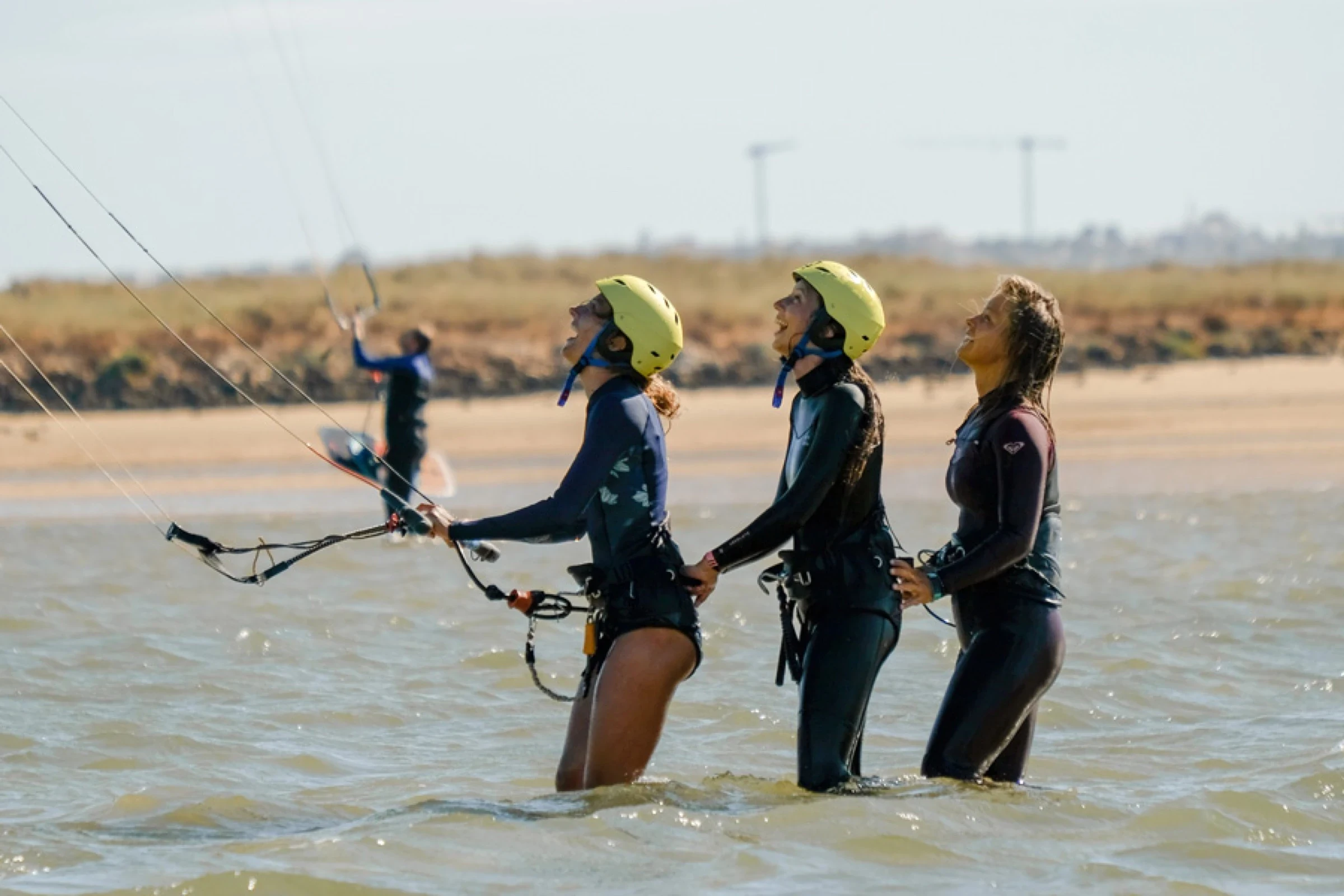
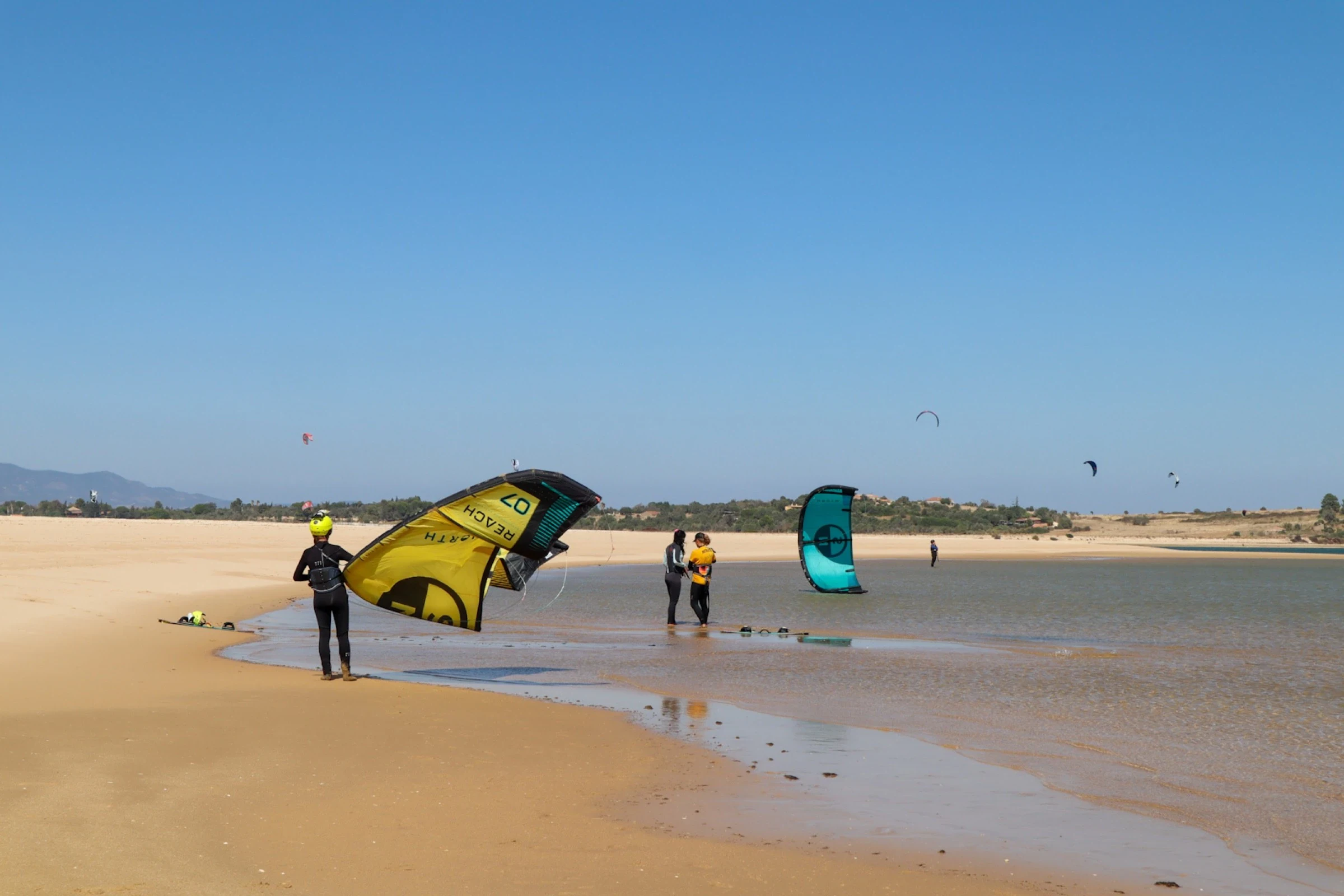
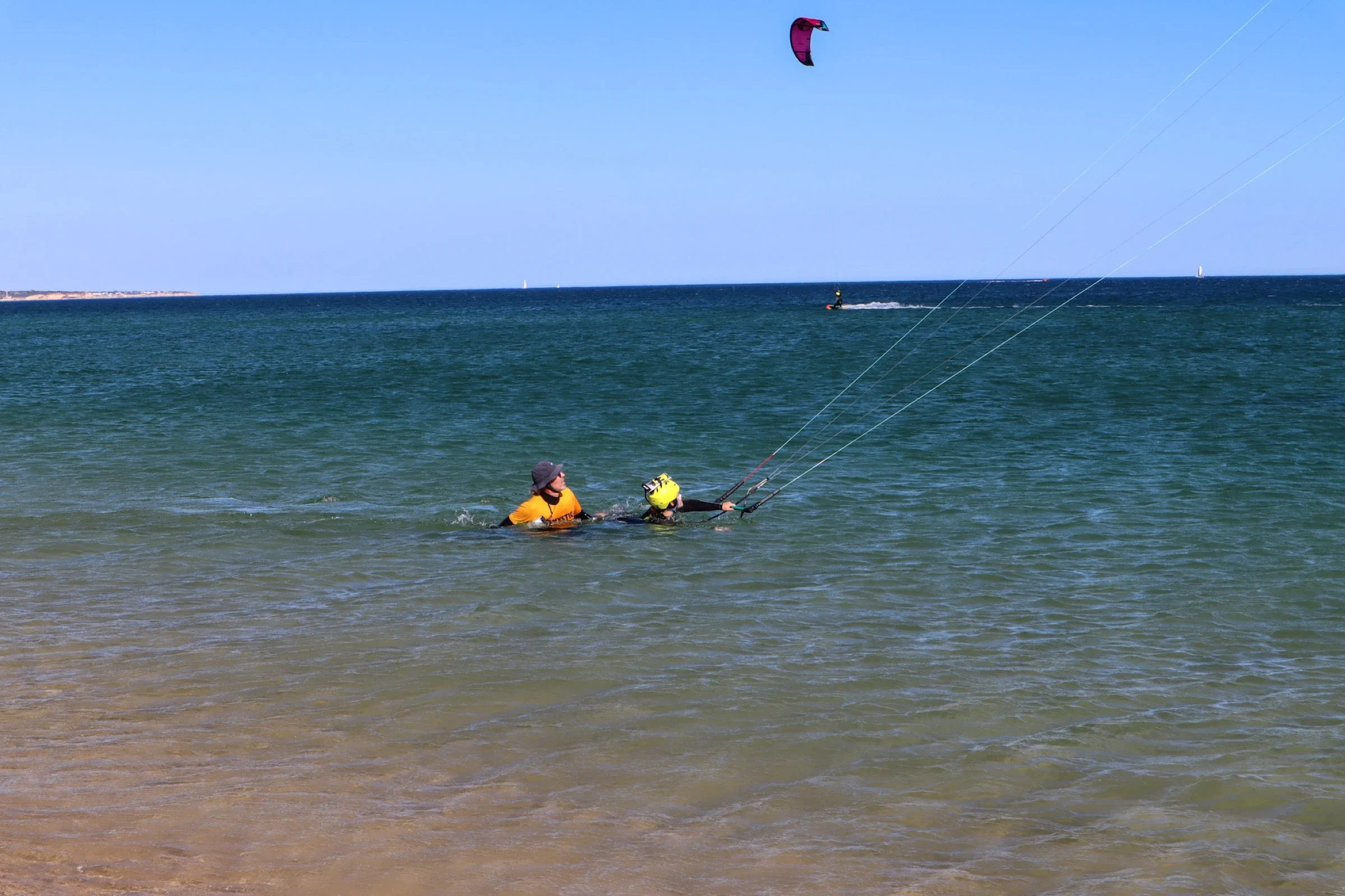
Almost all kitesurfing lessons in Lagos happen at the Ria de Alvor, a flat-water tidal lagoon about 15 minutes from the centre of Lagos, between Lagos and Alvor. It has a sandy bottom, shallow water across the teaching area, and a reliable summer wind. For a beginner, it is one of the better places in Europe to start.
Once in a while, maybe a couple of percent of the time, the high tide gets too big for the lagoon to work well, and lessons run at Meia Praia, the long beach by Lagos, instead. Even a first day is fine there. Beginners stay on the beach, flying the kite out over the water, so it’s a different setting rather than a harder one. Riders who are already body dragging head into deeper water with boat support.

Is the Alvor lagoon safe for beginners?
Yes, and the reason is simple: you can stand up. The lagoon has a sandbar running through the teaching zone where the water sits around waist to chest height, so when something goes wrong, and it will, that’s how you learn, you plant your feet instead of getting tumbled. The bottom is sand, the water is flat, and there are no waves knocking you off balance while your brain is busy learning to fly a kite.
Two honest things to know. The lagoon has tides and some currents, and the layout shifts at high tide, so it’s not a spot to wander into blind. Learning with a school, or at least asking locals and reading a proper Alvor lagoon spot guide, means you know where to go and where not to. And the wind is a thermal, so it can be a little gusty. It is reliable though: once it starts blowing it usually holds until the evening, and for learning, that is good wind.
Why a lagoon beats the open ocean for learning: in waves and deep water, a beginner spends half the lesson dealing with the environment, getting pushed around, swimming back to position, losing the board. On the lagoon, the water does none of that. You focus entirely on the kite.
On the rare days lessons move to Meia Praia for deep water, there’s a safety boat and radios so the instructor stays in constant contact and brings riders back to shore. Beginners on those days stay on kite control and small body drags, never out of their depth.

How hard is kitesurfing to learn, and how long does it take?
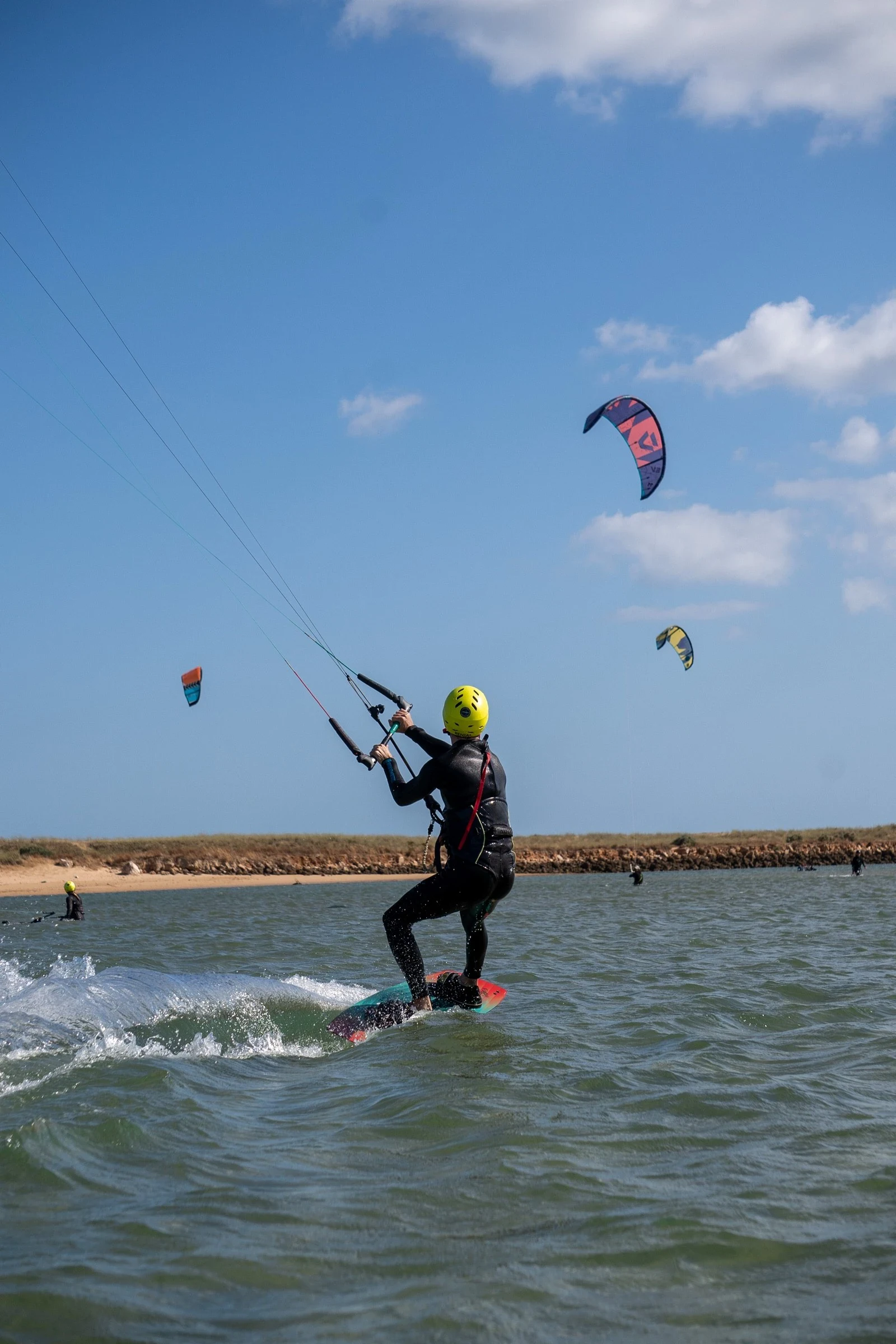
Most people complete the full beginner progression in about five days, and by the end the majority have had water starts with some early riding. Kitesurfing has more moving parts than most water sports, so the first couple of days are about one thing: controlling the kite. The board comes later, and once the kite is second nature, the rest comes together faster than people expect.
- Day 1: Kite control. Safety briefing, how the wind works, the wind window, setup and quick-release systems. Then onto the lagoon to fly the kite. The whole focus is making sure you control the kite, not the other way around. Maybe some small body drags by the end.
- Day 2: Body dragging. Using the kite to pull you through the water in the direction you choose. This is where power control clicks.
- Day 3: Water starts. Bringing the board in and getting up. Many schools split this with a wake park day, because a cable wake-park start feels almost identical to a kite water start. You learn the board without also juggling the kite.
- Days 4 to 5: Riding. Getting up, holding it, building distance. Some people ride a long way by day five, others get their first few metres. It varies with fitness, prior board experience, and the wind that week.
Roughly fifteen hours of instruction gets most people to a competent first level, a far faster curve than something like windsurfing. How far you get in five days depends a lot on you: your fitness, any board experience, and the wind that week. The structure here is built to get you on the board as soon as your kite control allows.
“I made a lot of progress in kitesurfing, basically from zero to riding in the direction I wanted. Big shoutout to Franek, Adrian, Manouk and all the experienced kite teachers.”

Why do beginners learn on short lines?
Beginner lessons usually start on shorter lines because shorter lines make the kite safer. With shorter lines the kite flies through a smaller wind window, so it can’t travel as fast or generate as much pull. Less power means a more forgiving kite while you’re still learning to steer. As your control improves, the lines get longer and the kite gives you more to work with. It’s a simple way to take the intimidation out of the first sessions.

Group, semi-private, or private: which should a beginner pick?
For most first-timers, a group lesson is the best place to start. There are three formats:
- Group (3 hours, max 4 students). You share a kite with one other person. While your partner flies, you watch, and in the early days that rest time is useful. Your brain is processing a lot of new information, and watching someone else work the kite is part of how you learn. It’s also the most affordable way in.
- Semi-private (2.5 hours, your own kite). The sweet spot for progressing quickly once you’ve got basic kite control. More time on the kite, more water time.
- Private (2.5 hours, one-to-one). Full instructor focus for specific goals or faster progress.
Small groups matter more than people realise. The fewer students per instructor, the more time you get on the kite, which is what you’re paying for. Not sure where you’d start? The kite level guide breaks down each stage.

How much do kitesurfing lessons in Lagos cost?
A full beginner group course in Lagos works out to the mid-€400s for five days, with everything included: kite, board, wetsuit, harness, helmet and transport to the lagoon. If you’d rather have a kite to yourself the whole time so you progress faster, a semi-private course is in the mid-€600s. Both are in line with what you’d pay at other established European kite spots.
Where the cost stands out is against North America. In the US, lessons commonly run more than $100 an hour, so the price of a full five-day course in Lagos buys you barely two days there. For anyone weighing up where in the world to learn, Europe is strong value, and the Algarve sits comfortably within it. You can see current lesson options on the Lagos kite school page.
What should you bring, and what should you expect?
Most of what you need is provided, so the list is short. The one thing worth packing is a pair of reef booties if you own them. The lagoon floor is mostly soft sand, but there are shells dotted around, and soft feet can pick up the odd small cut. Booties solve that. Beyond that, bring swimwear, strong sunscreen and water, because you’ll be out in the afternoon sun.
Expect a relaxed rhythm. The wind here tends to fill in during the early afternoon, so mornings are usually free for slow coffee, the wake park, or resting up before your session. Expect to be tired in a good way after a lesson too. Flying a kite for three hours is more physical than it looks, and the learning happens in your head as much as your arms. Especially the first day or two, there is a lot of new information at once and it can feel overwhelming. That is normal, don’t worry about it. It settles quickly, and the payoff lands fast once kite control clicks.

What happens if there’s no wind?
You switch sports. This is one of the quiet reasons Lagos works so well for a kite trip. If the wind doesn’t show, you go surfing, paddleboarding, or to the wake park instead, and any unused lesson value can go toward another activity rather than being lost. Kitesurfing depends on wind, and no honest school can promise it every day. What matters is what happens on a flat day, and here it’s a different sport rather than a wasted one. When the wind comes back, kiting takes priority again.
When is the best time to learn kitesurfing in Lagos?
The kite season runs from roughly May to September, and June, July and August are the most reliable months for wind. The wind itself is the Nortada, a north thermal breeze that usually fills in during the early afternoon, sometimes switching on quite suddenly. That afternoon pattern suits a relaxed trip: mornings are free, and lessons run when the wind arrives, usually in the 15 to 25 knot range that’s ideal for learning.
The shoulder months, late spring and into autumn, can still deliver good days, but the wind is less of a sure thing, the same as it is at most kite spots outside peak season. If reliable wind is your priority, aim for the heart of summer.

Is it worth doing the full kite camp instead of just lessons?
If you’re travelling to Lagos specifically to learn, the kite camp often makes more sense than booking lessons alone, and not only for the kiting. Once you add up accommodation, food and transport separately, an all-inclusive camp can be the budget-smart option, because it’s all organised in one place. You’re not sorting out where to stay or eat after a tiring afternoon on the water.
There’s also more learning packed in. You can ask the instructors questions off the water, there are theory sessions, a wake park day that doubles as board-skills practice for kiting, and the flexibility to switch to another sport on a no-wind day without it costing you the trip. Lessons are the right call if you’re already in Lagos and want to try it. The camp is the better fit if kiting is the reason you’re coming.
Frequently Asked Questions
The questions we hear most from beginners before their first kitesurfing lesson in Lagos.
No. Lessons include the kite, board, wetsuit, harness, helmet, and an impact vest where needed, plus transport to the lagoon. The only thing worth bringing is a pair of reef booties if you have them, since the lagoon is sandy but has the odd shell underfoot.
Yes. Most beginners arrive having never flown a kite or ridden a board. The first days are all about kite control, which is its own skill, and the board comes once that is solid. The wake park day is specifically there to help non-board-riders get the feel of a water start.
Yes. The best thing is to fly a small two-line trainer kite beforehand. You can pick one up cheaply from Decathlon or a kite shop, and even a few sessions in a park gets you used to steering and feeling the wind window, so your first lesson can move past the absolute basics faster.
Lessons follow IKO and VDWS standards, and a VDWS licence is available. It certifies the level you have reached and lets you rent equipment at kite schools worldwide that recognise it. You can take it during a course or come back for it later.
A group lesson is a maximum of four students per instructor, with two people sharing one kite. Smaller groups mean more time on the kite for you.
Like any board sport it has risks, but learning on a shallow lagoon with certified instructors, short lines, a helmet and an impact vest is about as controlled an introduction as the sport offers. You can stand up in the teaching area, which removes a lot of the fear.
Kite lessons are for ages 16 and up.
Book Your First Kitesurfing Lesson in Lagos
VDWS and IKO certified instructors, a flat-water lagoon built for learning, and 20 years of teaching in Lagos. All equipment included.