
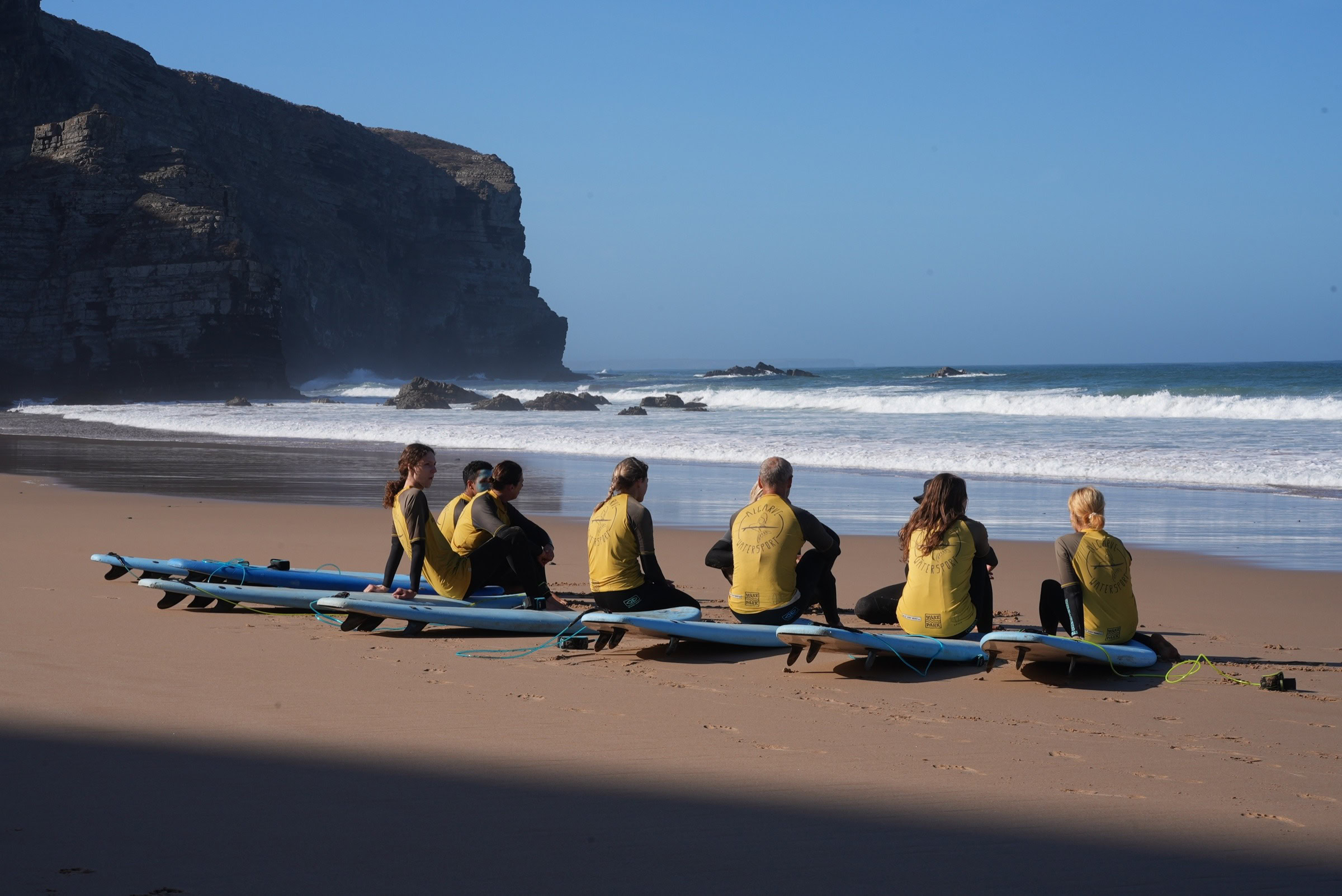
Surf Camp for 30-Year-Olds: What It’s Actually Like
Thinking about surf camp in your 30s? Here’s what the experience is actually like — who goes, what happens, and why the age worry is usually the first thing to disappear.
Most people start thinking about surf camp in their late 20s. Then life moves on and the idea stays on the list. By 30 or 32, the question usually shifts from “I want to try this” to “is it still realistic?” — whether that means fitness, fitting in, or just whether the whole thing still makes sense at your age.
The short answer: the average first-time surf camp guest is not a teenager. Most people who book a week of lessons are working adults who’ve taken annual leave to do something they’ve been putting off. The age worry is one of the most common things people arrive with, and one of the first things that disappears once they’re in the water with a group of people in exactly the same position.
Is 30 too old to start surfing?
Surfing has an image problem. The people you see in the water, on social media, in surf films — they started young. That creates a false impression that learning as an adult is unusual, or that the window has already closed.
It hasn’t. Surfing rewards patience and body awareness more than raw athleticism. Adults tend to listen to their instructor, warm up properly, and not charge waves they’re not ready for. That makes the learning process faster. The 16-year-olds catching clean waves on YouTube got there by spending years in the ocean. That’s a product of hours in the water, not of being young.
Beginners in their 30s are not unusual at surf camp. They’re the most common type of guest.
Who actually goes to surf camp at 30+
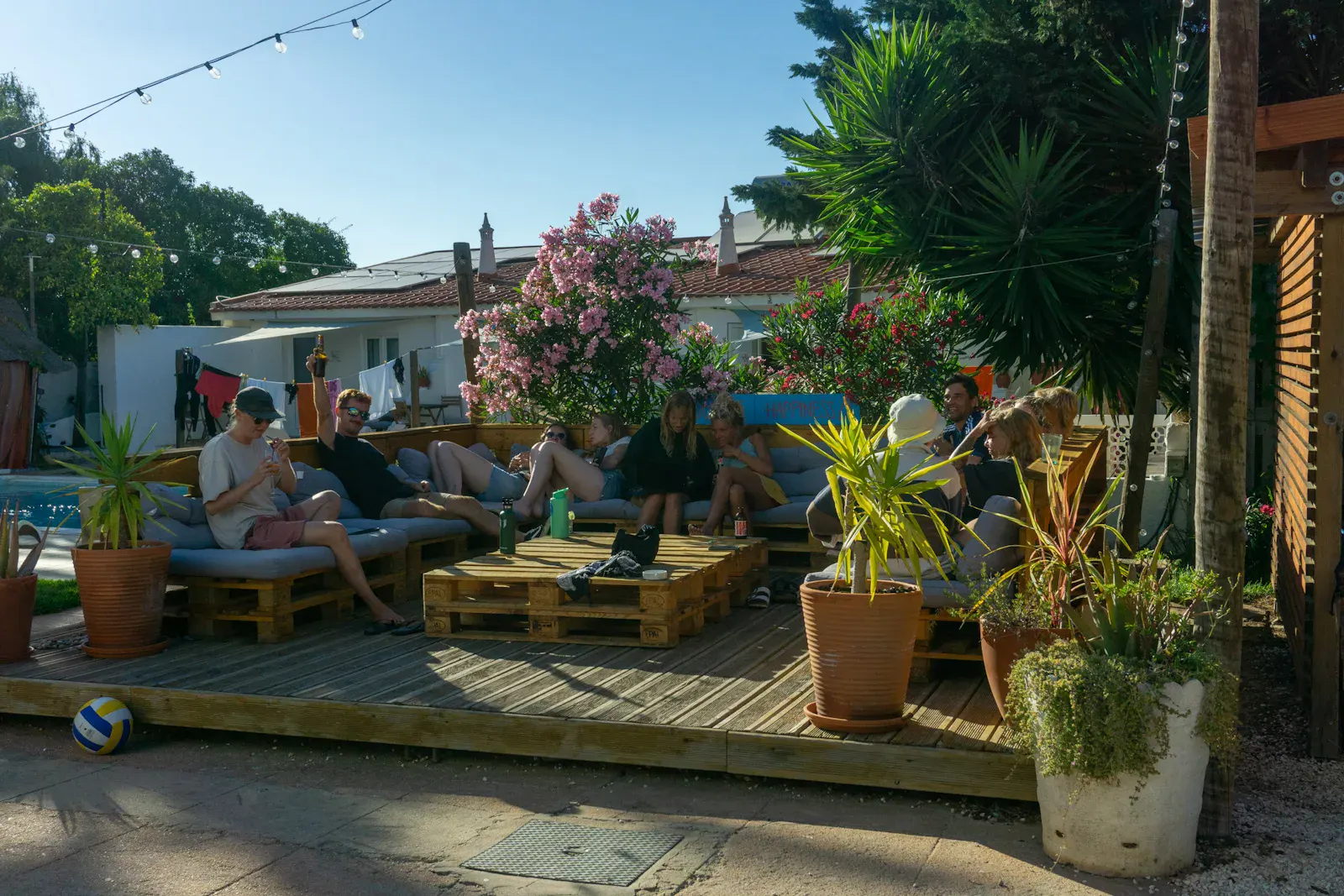
Surf camp, as an industry, markets itself heavily to younger travellers. The photography is all 20-year-olds, the social media is all gap years. The actual guest lists tend to look quite different.
The typical surf camp beginner is in full-time work and has taken annual leave to do this. Some come with a partner, a lot come solo. Most have been thinking about it for two or three years and finally pulled the trigger. The gap-year crowd exists — but it’s not the majority, and it’s rarely most of the people in your lesson group.
At our camp in Lagos, for example, the biggest single age group is 30 to 34, about 30% of all guests. The second largest is 25 to 29. Combined, people in their late 20s to mid-30s make up most of the camp on any given week. Your instructor will probably be around 30 too.
“Ideal atmosphere for chilling and making new friends.”
TripAdvisor reviewThe things people worry about before they arrive are usually the same three:
- Will I be the worst person there?
- Will everyone else already know each other?
- Will I be surrounded by 19-year-olds?
On the first two: almost everyone in a beginner group is a beginner, and almost everyone arrives not knowing anyone. On the third: the age mix is usually older than people expect.
There’s also a reason people book surf camp that doesn’t show up in any brochure. A week where meals are sorted, transport is sorted, and the only decision is what to do with your afternoon is harder to find than it sounds. A lot of people describe it as a mental reset as much as a sport holiday. The surfing gives the week a shape and gives you permission to switch off.
“Being surrounded by so many positive and happy people and having so many exciting experiences made me want to stay there forever.”
TripAdvisor, Kitehouse reviewWhat a week looks like
You probably picture surf camp as an all-day session in the ocean. It’s not. There are surf lessons, structured and small-group with a certified instructor in the water, but they’re not your whole day. The rest of the time is yours.
A typical day
The social rhythm of the week
Wednesday is pizza night. It’s the social anchor of the week: by that point, people who arrived as strangers have had a few days in the water together and the group has gelled. Most guests say it’s the highlight of the week as often as any surf session is.
If you want to stay out longer after dinner, that’s fine. If you want to go to bed at ten, that’s fine too. The camp isn’t trying to organise your evenings. Some people go out into Lagos. Some people sit around the bar area with hammocks until it’s late. Both happen in the same week.
“Meals were really sociable, and conversation kept going long after dinner.”
TripAdvisor reviewMost people are surprised how quickly the week passes, and how much easier it is to meet people than they expected. Learning something new in a small group does most of the social heavy lifting.
Do you need to be fit?
You don’t need to train before you come. But surfing uses specific muscle groups, and knowing which ones helps set expectations.
Paddling works your shoulders and upper back. If you haven’t used those muscles much, the first session will find them. By Day 3, the soreness is gone and you’ve built enough muscle memory to paddle more efficiently.
The pop-up is a fast push-up movement. Technique matters more than power at beginner level. People who do yoga tend to find it comes quickly. People who run but don’t do upper body work sometimes need an extra session to get consistent.
Balance is more about relaxing than tensing. Rigid legs fall off the board. Bent knees and loose hips stay on it.
The one actual requirement: you need to be comfortable in moving water. You don’t need to be a strong swimmer. Lessons happen in the white water zone, close to shore, with a leash connecting you to a foam board that floats. If the ocean makes you anxious, tell us before the session starts. We can work with that.
We teach guests across every fitness level. The people who struggle most are often the ones who try to muscle through it rather than listen. The people who progress fastest are usually the ones who take the coaching on board and stop overthinking.
If you walk regularly, swim occasionally, or do any form of sport even irregularly, you have enough baseline fitness. The week itself will build the rest.
The first lesson: what to expect
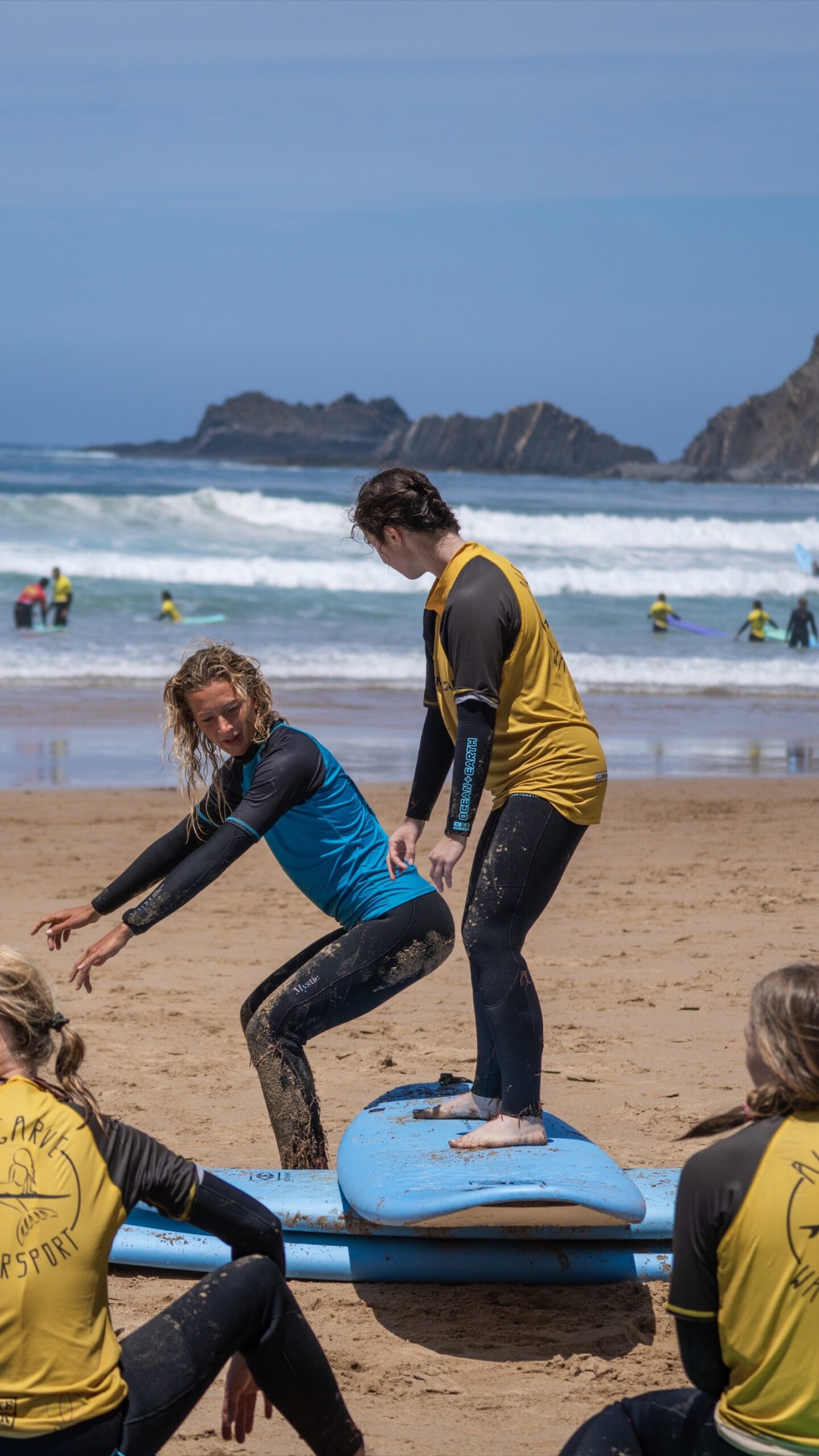
I’ll describe this from start to finish, because the uncertainty about Day 1 is usually what holds people back from booking.
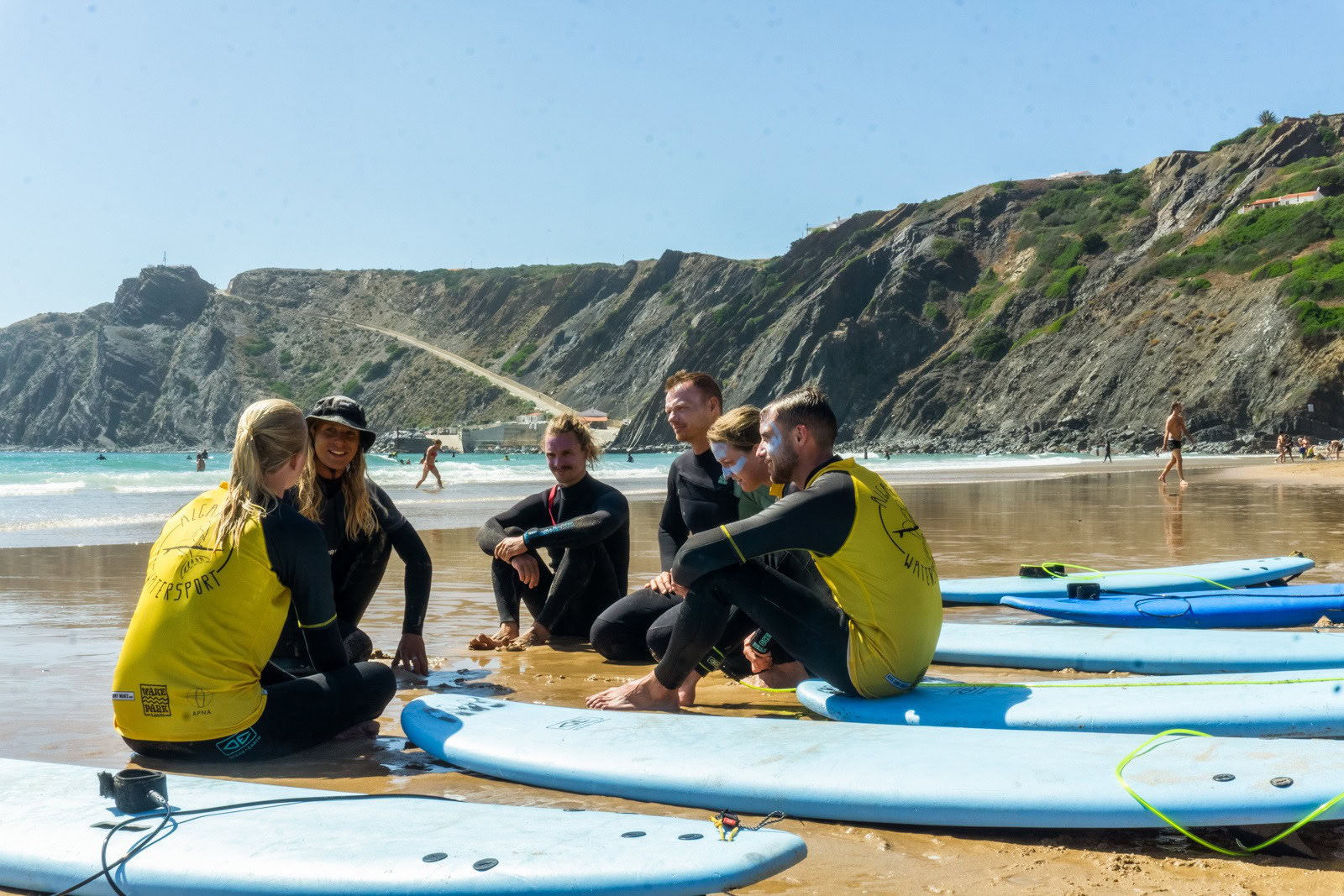
You arrive at the beach with your group. Everyone is in the same position: most people have never been on a surfboard. We do a warm-up on the sand and a proper briefing — how the ocean works, where we’re surfing, what to watch out for. No technical jargon. Plain language.
Then we do the pop-up on dry sand. You’ll feel ridiculous. Everyone does. It doesn’t matter. This is where technique gets locked in before the water adds the difficulty.
Then we go in. The white water zone is exactly what it sounds like: the already-broken waves, rolling in toward the shore. It’s shallow. The foam board is large and buoyant. Your instructor is next to you, or just in front, calling the wave and helping you onto it. The first few attempts are chaotic. That’s normal.
By the end of the session, most people have stood up at least a few times. Hard to describe if you haven’t experienced it.
What Day 1 is actually for
Day 1 is foundation work, and that’s what makes the rest of the week possible. Getting comfortable in the ocean, locking in the pop-up, catching whitewater waves. Don’t skip ahead in your expectations.
About wipeouts: you will fall off the board. Often. On Day 1 this feels dramatic. By Day 3 it’s just part of the session. The standard advice: fall flat, cover your head with your arms as you surface. Your instructor covers this in the briefing. The foam board and leash bring you back to the surface quickly.
Most first-timers tell us Day 1 was exhausting and Day 2 was when it started to click. That’s an accurate description of how learning this works.
Why the Algarve for adult beginners
The short version: warm water, consistent Atlantic swells, mellow beach breaks, and the right surf infrastructure for people learning at adult pace.
The water temperature
The Algarve Atlantic runs between 17 and 22 degrees depending on season. That’s warm enough that you’re not spending mental energy on being cold. A 3mm wetsuit handles it comfortably. Cold water surf destinations put a psychological load on beginners that the Algarve doesn’t.
The beach breaks
We choose from several beaches on the west Algarve coast depending on conditions: Arrifana, Amoreira, Monte Clérigo, Porto de Mós and others. The selection is based on the forecast the night before. Beginner lessons go to beaches with consistent, manageable white water. No one puts a beginner on a reef break.
The Atlantic beach breaks in this region produce waves that are readable and forgiving at beginner level: long enough to give you time to stand, soft enough that a wipeout doesn’t punish you. That’s not true of every surf destination.
The multi-sport option
If a day’s surf conditions aren’t right for beginners, or you want to try something different in the afternoons, we have five other sports at the same location: kitesurfing, wing foil, windsurfing, wakeboarding and SUP. We’re the only multi-sport water sports camp in Lagos. For adult beginners who want to make the most of a week away, that flexibility matters.
We’ve also been running camps in Lagos since 2006. The infrastructure, the contacts with local beach authorities, and the reading of local conditions comes from years operating in the same area. That translates into better session quality for you.
Going alone vs with a partner or friends
Coming solo
A significant portion of our guests arrive alone. The camp structure means you don’t have to work to meet people. You’re doing something physical with a small group every day, sharing breakfast and dinner at the same table, and learning something hard together creates a shortcut to actual conversation.
The maximum group size in the water is six adults per instructor. That’s a small group. By the end of the week, most solo travellers know the full camp, not just their lesson group.
“The vibe was really cozy and chill, which made it super easy to feel comfortable — even though I was travelling solo.”
TripAdvisor reviewIf the social side is something you’re anxious about: everyone else is also there either solo or with one other person. Nobody is part of an intimidating established group.
Coming with a partner
Works well if you’re at similar fitness levels, but fine if you’re not. Groups are formed by level, not by who you arrived with. If one of you progresses faster, you’ll be in different water positions within a lesson, and both people get more useful feedback that way.
Coming with friends
The social side takes care of itself. The main consideration is booking far enough in advance that the group can get accommodation together. Dorm rooms are available, as are private options depending on season.
Prices from €780 per person per week in low season, including accommodation (dorm), all breakfasts and dinners, surf lessons, and all equipment. High season from €880. Peak from €950. See what’s included at the surf camp.
Frequently asked questions
No. Most guests at our surf camp in Lagos are in their late 20s to mid-30s. 30 is not a notable age in that group. You’ll be learning alongside other adults at a similar stage of life, not surrounded by teenagers. We’ve been running camps since 2006 and teach guests across every age and fitness level.
The biggest single age group is 30 to 34, around 30% of all guests. The second largest is 25 to 29. Combined, people in their late 20s to mid-30s make up the majority of the camp. It’s a working-adult crowd: people booking a week off, not students on a gap year.
You don’t need to train before you arrive. If you can swim and are comfortable in the ocean, you have the baseline. Surfing works your shoulders and back for paddling, and your legs for balance, muscles that wake up during the week. People who haven’t done regular sport in years manage fine.
Breakfast is included every morning at the Kitehouse. Surf lessons run for 2 hours: around 20 minutes of beach warm-up and theory, then roughly 1.5 hours in the water. Afternoons are yours: rest, explore Lagos, try another sport, or use the pool. Dinner is included every evening. Wednesday is pizza night, the social highlight of the week.
Day 1 is about foundation: getting comfortable in the ocean, practising the pop-up on the beach, and catching your first whitewater waves. Most beginners get their first proper ride on Day 2 or 3. Pace depends on conditions and individual comfort. We don’t make promises about specific milestones.
Yes, and many people do. A large portion of our guests arrive solo. Lessons run in small groups, a maximum of 6 adults per instructor, and the camp structure means you spend the week with the same people. Most solo travellers leave knowing the whole group. The social side happens naturally. We don’t force it.
Ready to actually do it?
Surf camp in Lagos. All lessons, accommodation, breakfast and dinner included. From €780 per week.